The Consortium recently convened an Innovation Lab session in Barcelona, Spain, where we spent two days focused on exploring how KCS and collaboration practices allow for healthy and successful automation and AI implementations.
Thank you to PTC, who hosted 18 people from 12 Consortium for Service Innovation Member companies at their new office! We heard from a handful of Members about their current approaches and experience, and enjoyed many Open Space topics of interest.
Themes Discussed
- The Reality Check: By learning from actual implementations and challenges at Consortium Member companies, the team worked on establishing foundational practices for success.
- Collaboration is Key: As AI delivers more and more ‘known’ answers, focusing people on the creative problem solving of new issues requires breaking down organizational silos.
- AI and KCS: The integration of AI with KCS was a key focus. While we can apply AI to KCS to augment and automate Solve and Evolve Loop processes or tasks, KCS is also a key driver of Generative AI solutions, which need current, relevant, structured knowledge and context to perform well.
- AI and the Workforce: Discussions on strategies to measure overall contributor value, upskill employees faster, and focus on aligning people with AI-powered tasks is key.
Matt Seaman presented updates on the Consortium’s work around thoughtful and strategic automation based on advancing AI capabilities, and Romain Garcia gave us an update on how PTC is driving employee and customer efficiency and experience with generative AI. We also heard how PTC is leveraging a full time coach and KDE rotation program in their KCS implementation.
Albert Myles from Red Hat talked about what comes after the AI hype cycle and the successes they’ve had experimenting with the power of transformers. See more about Red Hat’s approach with Knowledge-Powered AI. (Hot tip: don’t start without a clear data/measurement plan!)
We heard from Monique Cadena about how Ping Identity reduced resolution time, increased Engineer capacity, and improved the employee experience by implementing Intelligent Swarming, while managing big organizational change along the way.
Andy Kiendl from NetApp shared what they’ve learned along their journey, and the ways they’re taking action on the patterns and trends they’re mining from their mature KCS implementation.
Attendees hosted many topics of their own during Open Space, including exploring:
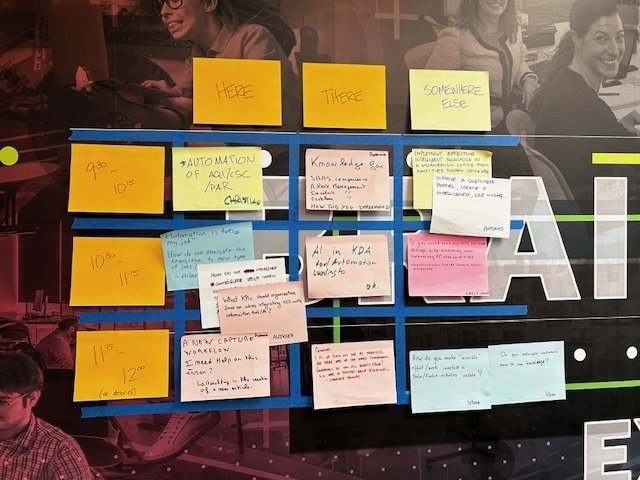
- Automating the Content Standard Checklist and Process Adherence Review
- Addressing the fear that “automation is taking my job.”
- A new capture workflow: creating an article if a case is not the trigger
- How do you make “invisible” effort/work invested in Solve/Evolve activities visible?
Consortium Members can find notes and slide decks from this meeting in the Member Only Wiki.
Artificial Intelligence is rapidly transforming how businesses operate. It comes as no surprise that service organizations are putting knowledge management, people, and customer engagement at the forefront of this next evolution. Sharing insights and experiences across companies allows us to clarify current capabilities and focus on the practical implications and implementations of AI in Services.

Structured approaches, attached to strategic priorities, with a mix of experimentation and prototyping, have been effective at realizing AI’s automaton abilities. In the coming months, Consortium Member companies will continue to iterate on developing a Blueprint for Automation leveraging advancing AI technologies. The blueprint will offer a framework for companies to navigate the complexities of AI implementation and achieve long-term success.
Stay tuned for updates, and visit Knowledge-Powered AI for more resources and Member experience with automation.
Member Recommendations
- Start with a Strong Foundation: You need data in many forms to power automation. A strong KCS implementation and other structured knowledge management practices are essential for AI.
- Modernize Your Systems: Update outdated systems for better integration and scalability with an eye for emerging technologies.
- Build a Collaborative Culture: Encourage knowledge sharing and cross-functional collaboration.
- Have a Plan: AI is a technology; leveraging it successfully requires strong operational transformation with Program Management and Organizational Change Management.
- Invest in People: Help employees adapt to new AI-powered roles and technologies. As tools advance, new skills and competencies will be needed across your enterprise.
- Measure and Iterate: Continuously track performance and refine your AI strategy based on prototypes, pilots, and business strategies.
P.S. We’ll share the latest on the Blueprint for Automation at Summit 2025. Hope to see you there!