Customer Experience Models
Understanding value, demand, and factors that shape customer experience.
Consortium for Service Innovation methodologies rely on Customer Experience Models to understand how value is enhanced or eroded within systems.
- Service Organization’s New Value – Reframe the role of service.
- Value Map Framework – Turn data into decisions and decisions into action.
- Customer Demand – Accurate and holistic view of customer interactions.
- Value Erosion Curve and Shift Left – Deliver value in the moment of need.
- Value Stack – Highlight dependencies for customer-realized value.
Service Organization’s New Value
Service organizations have an opportunity to create value in modern enterprises that extends far beyond issue resolution. The Service Organization’s New Value model helps organizations identify, communicate, and expand the contributions that service teams make to customers, employees, products, and the business.
The model provides a practical framework for understanding how service organizations generate value across multiple dimensions.
It helps leaders move beyond traditional measures of efficiency and cost toward a broader understanding of impact and business contribution.
Read more about the Service Organization’s New Value.
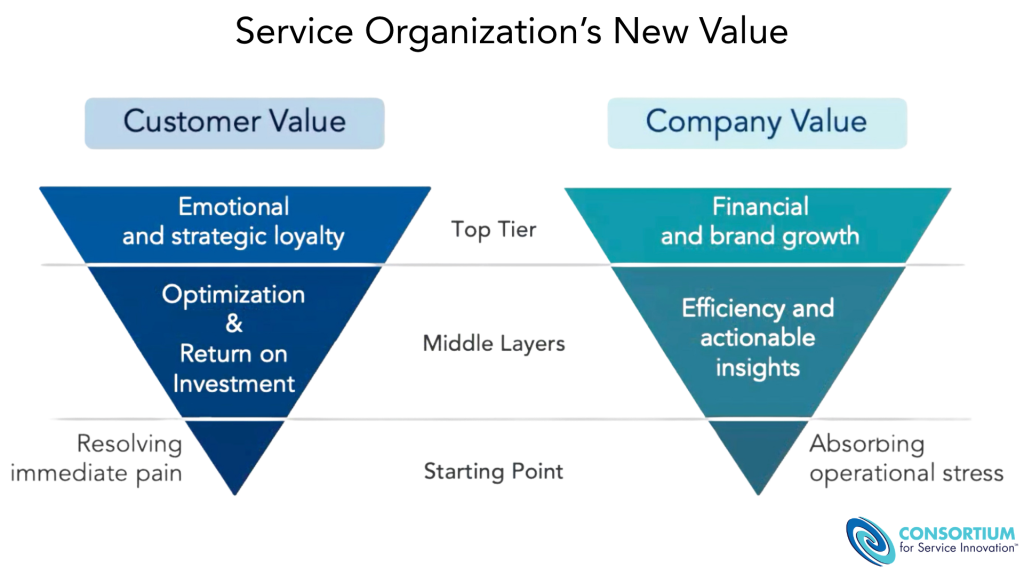
How to use the Service Organization’s New Value
- Expand focus. Articulate the full range of value your service organization creates across the enterprise.
- Reframe contributions. Connect service activities to business outcomes.
- Improve communication. Demonstrate impact more effectively to stakeholders and executives.
- Uplevel cross-functional alignment. Enhance the strategic role of service.
- Identify revenue opportunities. Discover possibilities to create new value.
Value Map Framework
Organizations collect more data than ever before, but data alone rarely drives change. The Value Map Framework helps teams connect operational measures and signals to meaningful business outcomes by creating a clear path from evidence to action.
The framework provides a structured way to move from raw data and observations to insights, recommendations, and ultimately decisions that influence customer experience, employee experience, and business performance.
It helps organizations tell a compelling story about value that leaders can understand and act upon.
Read more about the Value Map Framework.
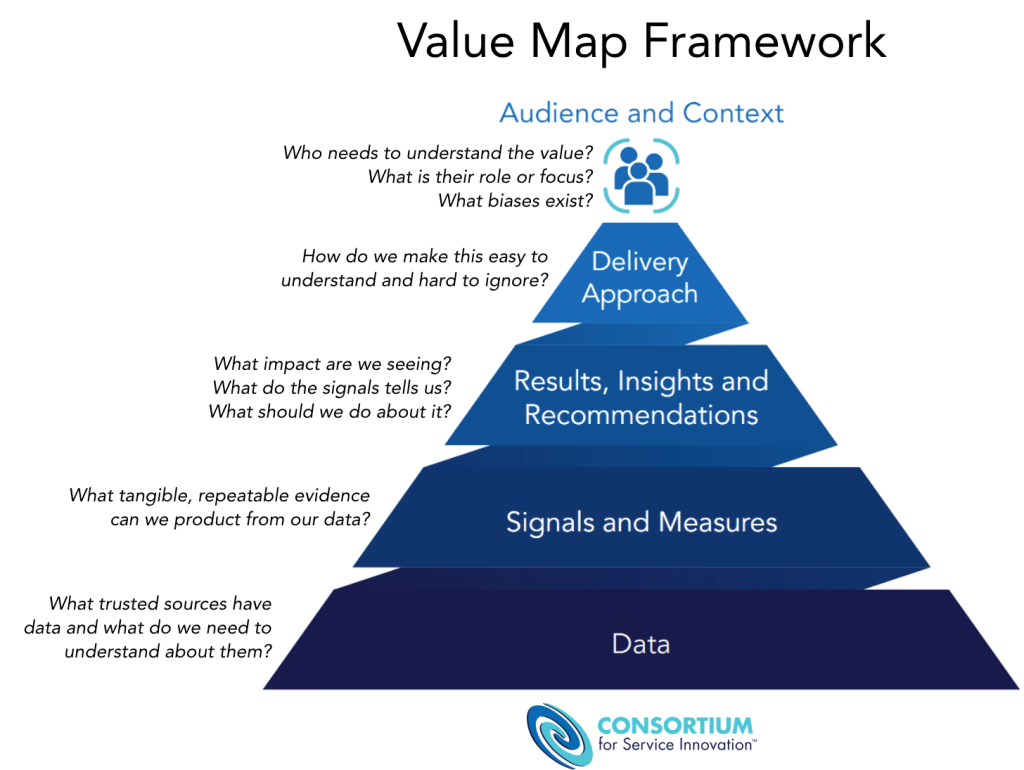
How to use the Value Map Framework
- Identify lagging indicators. Connect data and signals to outcomes.
- Reposition the value of human agents. Translate operational performance into meaningful insights.
- Create compelling justifications for resources. Build stronger value stories for stakeholders and executives.
- Improve measurement strategy. Find gaps between what is measured and what matters.
- Standardize and scale. Create a repeatable approach for communicating impact as business evolves.
Customer Demand
Most customer demand is invisible in traditional metrics because only a small slice of customer interactions show up in assisted support channels. By understanding the full picture of demand, gain insight into where and how value occurs in the system. When leaders view demand as a network, they can spot gaps and prioritize improvements accordingly.
The Customer Demand model shows relative customer interactions per channel.
Reframe perspective from number of cases closed to number of value-seeking journeys enabled (or blocked). This shift is critical to elevate service from cost center to strategic value builder.
Read more about Customer Demand.
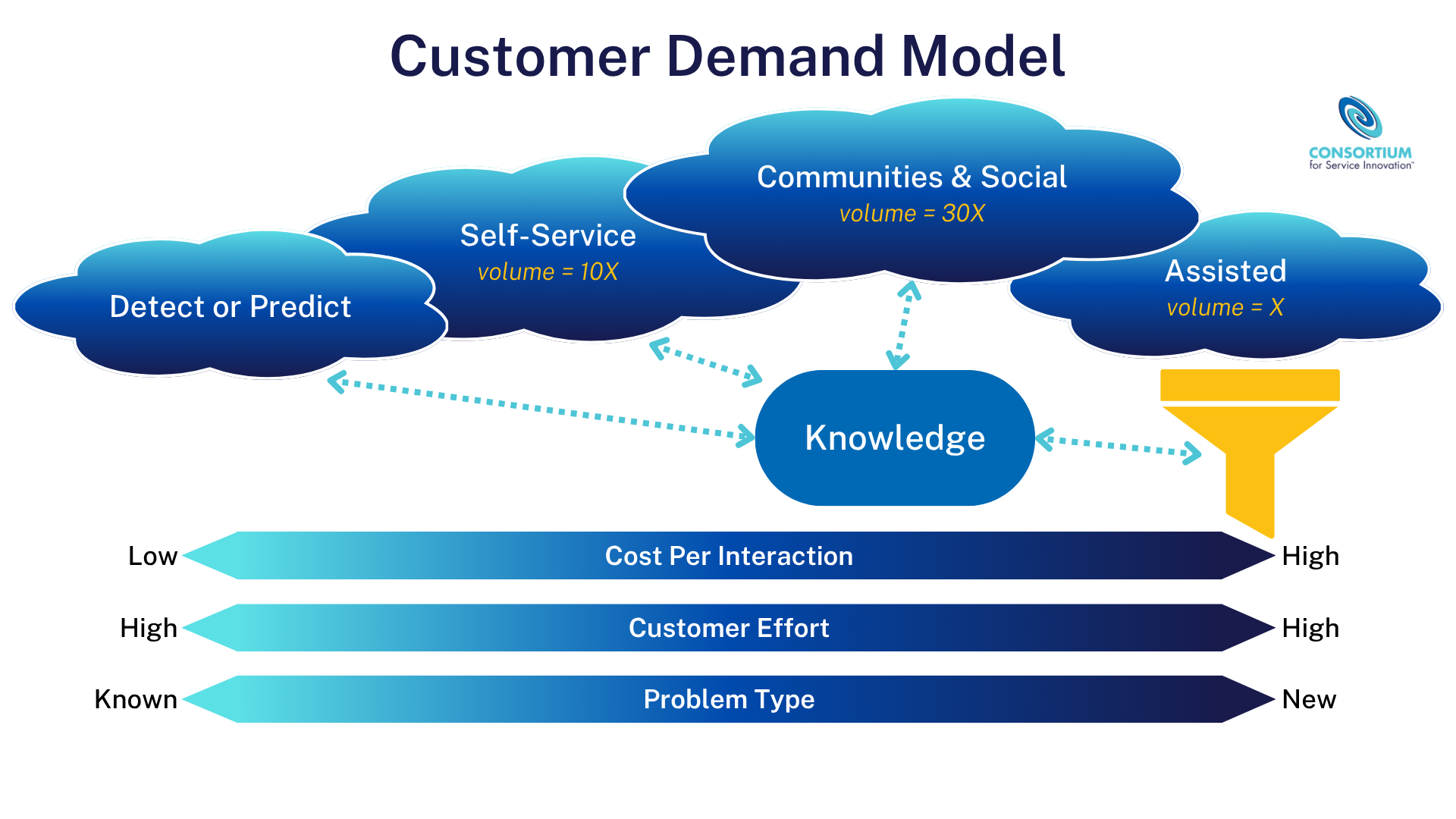
How to use the Customer Demand model
- Improve resource allocation. Map demand across channels to focus where to invest in a way that aligns with how your customers actually engage.
- Reduce customer friction. Enable customers to find value where they already are to improve customer satisfaction and allow knowledge workers to focus on higher value work.
- Speed up detection of emerging problems. Monitor flow in lower-visibility channels to catch root causes earlier.
- Support transformation and strategic growth. Shift from reactive support to a networked engagement model, support knowledge strategy, and align service operations with broader business outcomes.
- Reposition measurements and insight. Rather than only tracking cost avoidance, which is a limiting perspective, shift to tracking value delivered, demand served, and customer experience across all engagement channels.
Value Erosion Curve and Shift Left Strategy
Customer value erodes with every moment of delay between the customer’s need and the organization’s response. The longer it takes for a customer to access value, the less valuable the interaction feels to them. Time to value is a key differentiator for leaders accountable for growth, retention, or operational efficiency.
The Value Erosion Curve shows how customer value degrades if we don’t handle demand well.
To increase value, move closer to the moment of demand—Shift Left—to deliver as soon as possible in the moment of need.
Read more about components of Value Erosion.

How to use the Value Erosion Curve
- Improve value delivery (Shift Left). Move value closer to the customer’s moment of need: simplify access, reduce delays, and build systems that deliver answers before escalation.
- Make intelligent decisions about where to invest. Identify where digital, workflow, knowledge, or AI improvements will have the greatest return. Prioritize investments that accelerate value, not just automate tasks.
- Improve customer experience and retention. Shorten the time between need and value to strengthen trust and confidence.
- Optimize case interception. Improve self-service and automated resolutions to increase customer value, rather than just to avoid assisted support.
- Transform operations without losing the human element. Focus on touchpoints rather than technologies to design systems that combine smart automation, strong knowledge practices, intelligent workflows, and human expertise.
Value Stack
By highlighting dependencies for customer-realized value, we get smarter about how to shape customer experience. For leaders concerned with ROI, growth, retention, and competitive advantage, this model connects service operations to business outcomes and customer success. This transformation strengthens loyalty and opens new opportunities.
The Value Stack reframes the goal of service from “just fix problems when they happen” to continuously create and protect customer value.
Moving up the stack means working more strategically with customers, understanding their business context, and designing for their success.
Read more about the components of the Value Stack or an example of the Value Stack in action at Calix.

How to use the Value Stack
- Focus resource investment more wisely. Identify where you are on the stack, where your customers are expecting you to be, and which capabilities need attention to move upward.
- Shift from cost-center to value-creator. Climb the stack to elevate support and services beyond cost containment to include customer productivity, business outcomes, and mutual success.
- Improve customer relationships and retention. Move up to engage more deeply with customer business goals, co-create solutions, and become a partner rather than a vendor.
- Drive operational maturity and innovation. Build predictive capabilities, embed customer context in your workflows, and leverage knowledge and insights as strategic assets.
- Measure more meaningfully. Shift measures to reveal customer-realized value to align service outcomes with leadership priorities.
Delivering on Service Excellence involves strategy, culture, and leadership.
Latest News
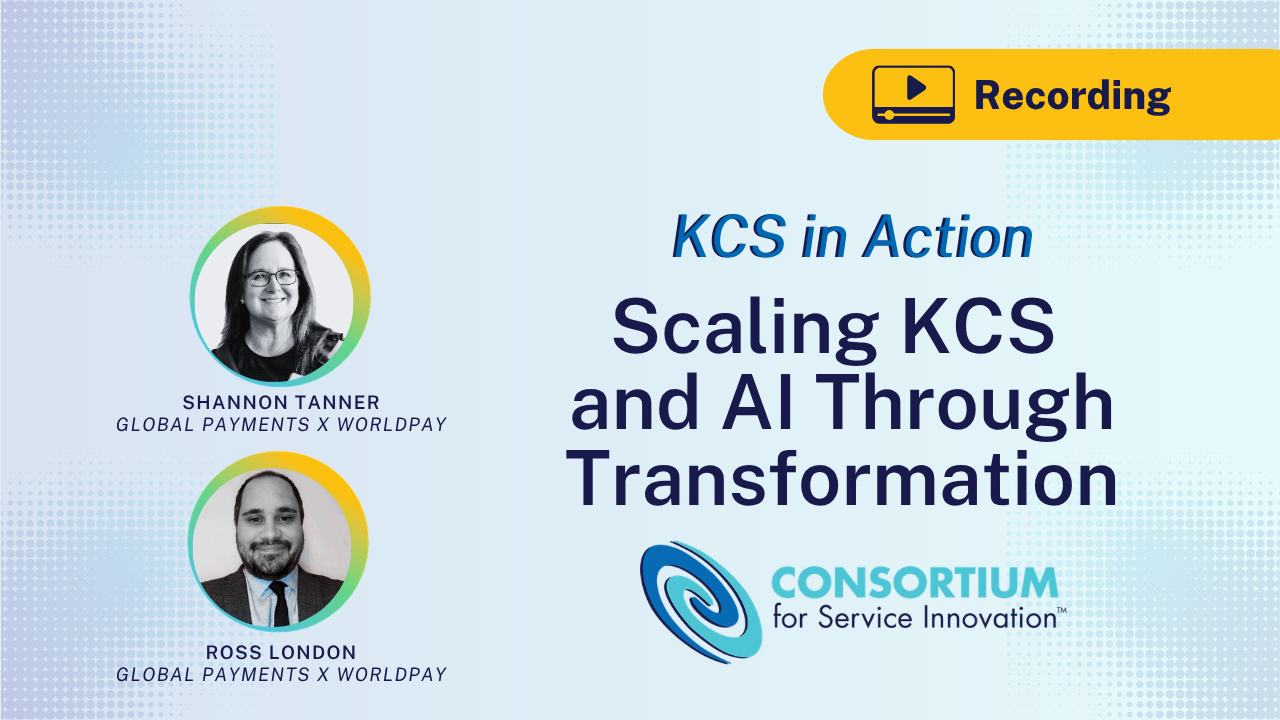
KCS in Action: Scaling KCS and AI Through Transformation
Shannon Tanner and Ross London from Global Payments x Worldpay describe lessons learned in sustaining a KCS program through ten years of change.
Support is a Value Engine – Stop Keeping it a Secret
As AI absorbs more transactional work, Support can no longer prove its importance primarily through volume, speed, and cost efficiency. It has to show how it creates customer outcomes, organizational intelligence, product quality, trust, revenue protection, and growth. We hosted a half-day virtual event to showcase our latest Member experience and guide folks through this…
Join our mailing list to receive updates about latest news and upcoming events.