As AI absorbs more transactional work, Support can no longer prove its importance primarily through volume, speed, and cost efficiency. It has to show how it creates customer outcomes, organizational intelligence, product quality, trust, revenue protection, and growth.
We hosted a half-day virtual event to showcase our latest Member experience and guide folks through this evolution.
Watch a summary clip or keep reading for highlights and takeaways.
Summary Clip
Consortium Members: Full replays and companion Measurement Transformation Playbook available in the Member Wiki (login required).
We are developing on-demand training for this topic. Join the waiting list.
Highlights and Takeaways
Support organizations create tremendous value, but often struggle to make that value visible to customers and the rest of the company.
Nobody is going to change the story for us.
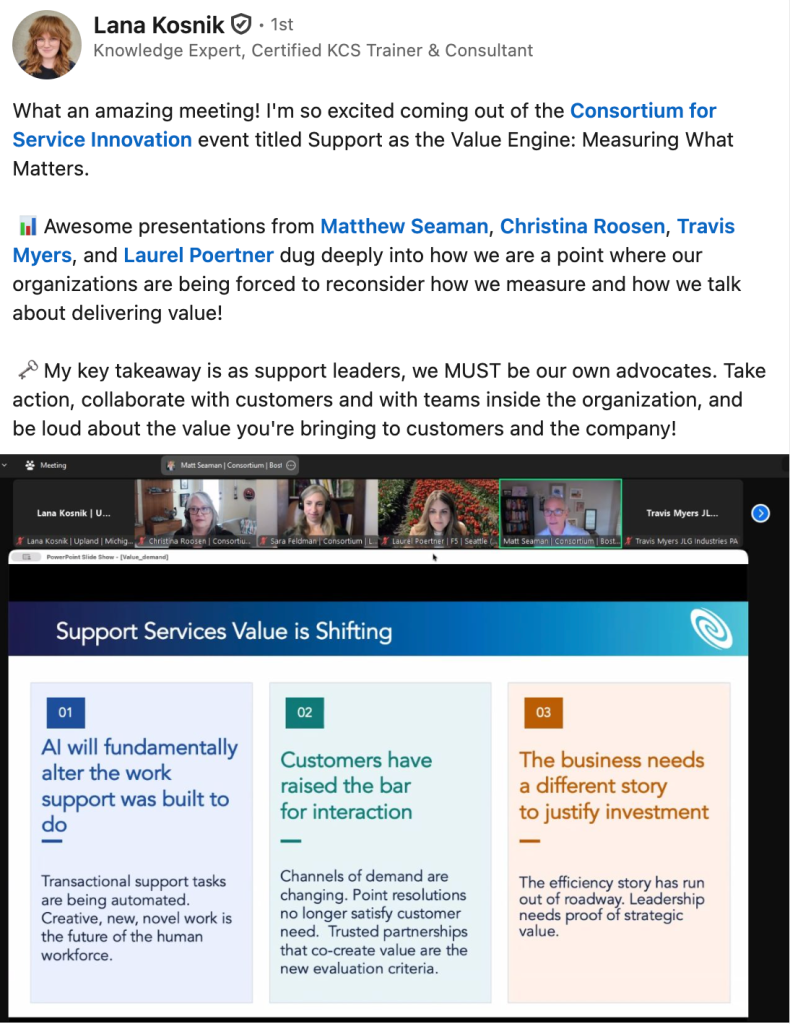
- AI is changing what support is built to do. As automation takes on more transactional work, people can focus on the creative, novel, and context-dependent work that creates differentiated value. Organizations will need new ways to recognize and measure those contributions.
- Customers are raising the bar. Answering questions and resolving problems are now baseline expectations. Greater value comes from building trusted partnerships, understanding customer outcomes, and co-creating value.
- The efficiency story is running out of roadway. Speed, volume, and cost, remain useful operational measures, but efficiency gains alone cannot demonstrate support’s full strategic contribution. Leaders need evidence of outcomes such as trust, product improvement, risk reduction, customer success, and revenue protection.
- Support needs two connected value stories. One story explains the value being created for customers. The other shows how that work creates value for the company. The stories reinforce one another, but they require different measures, language, and emphasis.
- The right story depends on the audience. The Value Map Framework provides a structured way to move from data and measures to insights, recommendations, and a credible narrative. Its layers may look simple, but applying them requires real work: understanding the data, choosing the right delivery approach, and knowing what a particular audience cares about.
- JLG and F5 demonstrated two different ways a value story can create change. Travis Myers showed how JLG is repositioning support around product quality, engineering integration, and competitive advantage. Laurel Poertner showed how F5 used customer-journey evidence and an ROI model tailored to executive priorities to secure funding for a customer-facing AI assistant. Although their industries and immediate objectives differ, both examples show the importance of connecting support’s work to outcomes the wider business values.
Agenda Overview
- Foundation for Value
- Matt Seaman, Consortium for Service Innovation
- Storytelling in Practice
- Christina Roosen, Consortium for Service Innovation
- Organizational Transformation
- Travis Myers, JLG
- Executive Funding for AI
- Laurel Poertner, F5
We know the practical place to begin. The challenge now is to examine what your organization measures, identify the value those measures may be missing, and start telling a new story about what Support is empowered to do.