The Consortium for Service Innovation’s annual Executive Symposium brought together 30 leaders from 25 different companies to discuss the current state and future of Support Services.
While many industry conversations are focused on cost savings, headcount reductions, and loss of jobs based on AI, Consortium Member executives are finding it critical to help people see themselves in the future state.
With advancing AI capabilities (and a robust knowledge management practice) delivering known answers, we are experiencing a leap in automation possibilities which is having a dramatic impact on the role of our people. We need our talented humans focused on high complexity and high relationship-based work.
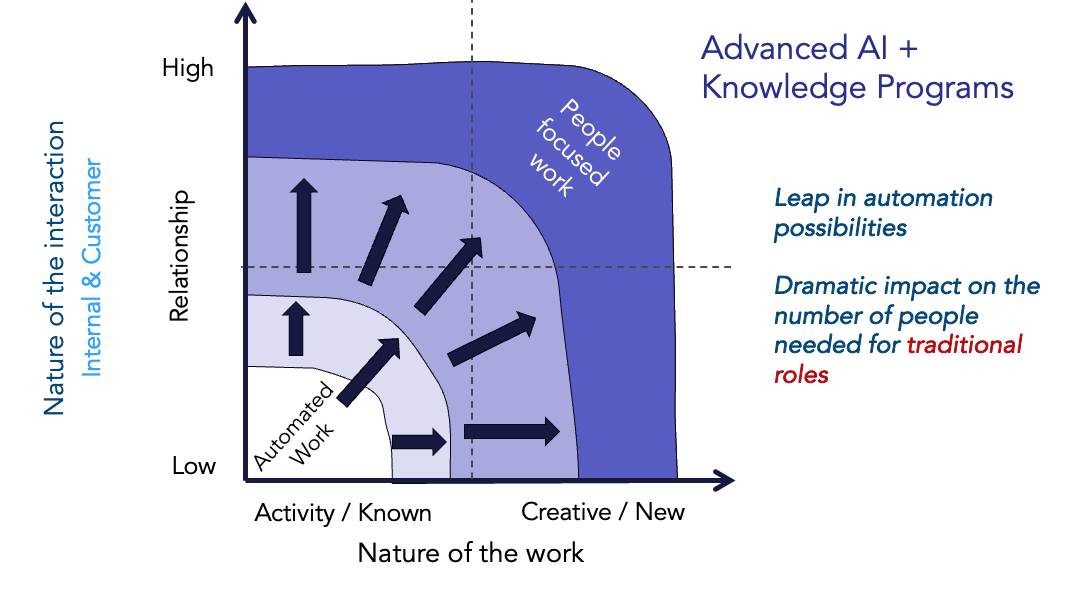
As the role of people in Support Services shifts
- from technical experts to customer advocates
- from isolated problem-solvers to strategic business partners, and
- from cost-center employees to company differentiators
Executives are focusing on creating a common understanding of goals and top-level objectives, being clear about desired outcomes and how individuals contribute to those outcomes, and recognizing the value of the work being accomplished.
Based on this shifting dynamic, we discussed three practical priorities for executives leading in the age of AI.
Reframe the Value of Support and Assisted Channels
Historically, support has been framed as a critical role, but not as a true value-adding differentiator in the company. Services leaders have recognized for years that the true value of a support team is not in simply answering questions, but in the direct knowledge of the customer experience and being able to connect their problems, needs, and experiences to other parts of the organization.
In his presentation on How the Value of Support Changes as our Channels of Demand Change, Ryan Mathews reframed the assisted channel as the learning channel. Whether customers are being assisted by humans or via automation, it’s an opportunity to uncover new problems, build relationships, and harness insights to fuel product, service, marketing, and sales improvements.
While services leaders recognize the holistic value support provides to the company, communicating this value is not always easy. We asked Mike Raley, SVP of Marketing at Coveo: if you were hired as a marketing consultant to sell the value of support to the rest of the organization, how would you go about it? Mike walked us through making a plan:
- Know Your Audience
- Define and Test Your Value Proposition
- Create Buzz with Facts and Emotion
- Repeat and Refine
Echoing the idea that support is not just about fixing issues but a chance to cultivate differentiation, customer trust, and knowledge that strengthens every other channel, we spent time building first drafts of value propositions for the C-suite, customers, direct leadership, and other parts of the organization.
- Action for leaders: Invest in reframing support’s story. Develop and test value propositions for support that emphasize learning, brand trust, and strategic impact.
- For Consortium Members: see the draft of new value propositions that attendees created during the Symposium.
Create Conditions for Innovation
Attendees acknowledged a familiar tension: innovate fast or risk irrelevance. But pressure to move quickly often squeezes out the very conditions that make innovation possible: trust, collaboration, and time to think.
Kelly Murray from the Consortium facilitated a conversation about creating those conditions, grounded in the Consortium’s Nurturing an Adaptive Workforce resources. Adam Mullen of Wolluhka Ventures highlighted systems thinking (drawing from Donella Meadows’ Thinking in Systems) to help leaders recognize hidden patterns and intervene more thoughtfully.
“Innovation is not an agenda item. It’s the product of the environment leaders create.”
– Observations on Innovation
Even when the larger system feels overwhelming, leaders have influence over their immediate environment and can spark cultural shifts by consistently modeling empathy and collaboration.
- Action for leaders: Protect space for experimentation, collaboration, and reflection. Describe iteration as being about learning instead of failing fast.
- For Consortium Members: see Embracing & Improving Collaboration, a previous presentation by Madison Hoffman at Zendesk about how she models this for her team!
Strengthen Foundation for Effective AI
A topic we kept returning to: AI is not a turnkey replacement. Scaling requires strong foundations in knowledge, clean data, connected systems, and clarity on the human roles that remain critical.
“A bad process automated with AI is still a bad process.”
– Koree Mires, Cisco
Today’s focus must be on strengthening knowledge management and self-service foundations, because AI outcomes are only as good as the content and context they pull from.
- Action for leaders: Align pilots with clear business outcomes and cultural readiness. Resist the pressure to scale before trust in data, systems, and people is in place.
- For Consortium Members: The AI Blueprint provides a detailed roadmap for successfully implementing AI.
The Leadership Imperative
The Symposium reinforced that leadership in this era is about balancing the capabilities of humans and machines.
Executives must:
- Reframe support as strategic.
- Invest in culture and systems for innovation.
- Scale AI with intentionality and strong foundations.
If organizations don’t look ahead and deliberately map out how people will contribute once repetitive tasks are automated, they risk losing both engagement and capability. Value in this new environment isn’t what people know, but how fast people can learn, shift mindsets, and design for what’s next. Leaders need to make space for that learning, ensure people feel safe to experiment, and nurture early-career talent so they’re ready to take on the more complex work that AI alone can’t handle
“AI brings major changes to how we work, and that presents an opportunity for leadership to step up and help their people navigate the ever-changing landscape by empowering them to be more human.”
– Lana Kosnik (Upland RightAnswers)
Artificial intelligence has raised the bar on leaders to deliver efficiency, innovation, differentiation, and resilience. The shifting nature of support is dramatically changing the way companies consider the value of Support Services organizations.
The work ahead goes beyond just adopting new tools, but is about shaping the environment where people can thrive alongside them. We hope you’ll join us at upcoming events where these conversations will continue.
Consortium Members have access to recordings and presentations from the Executive Symposium in the Member-Only wiki.