Build your measurement layer early. The data doesn’t just prove KCS is working, it tells you where to intervene.
Patrick Thams-Dimon, University of Copenhagen
Key Takeaways
People First
When we started treating KCS as an organizational change about the people, by the people, for the people, then change stuck.
Measurement is the Program
Build your measurement layer early. The data doesn’t just prove KCS is working, it tells you where to intervene.
Leadership is Required
Leadership needs to provide direction, be transparent, celebrate small victories, and do efficient communication.
Replay
Patrick Thams-Dimon, Knowledge and Lean Manager, describes the KCS journey at the University of Copenhagen, including challenges and insights.
Recap
The IT organization at the University of Copenhagen set out to implement KCS across a complex, distributed environment of ~400 staff members.
What started as a small pilot of 9 participants needed to scale without a dedicated knowledge management team, with limited data visibility, and during a period of significant organizational change.
The Challenge
Patrick’s team faced three major barriers:
- Organizational disruption: A university-wide administrative reform temporarily paused progress
- Lack of data visibility: Limited ability to prove value or guide decisions
- Experience gap: Leading large-scale KCS adoption without prior hands-on experience
Despite early momentum, these factors nearly stalled the initiative.
The Approach
Rather than forcing adoption, the team focused on building the right foundation.
Secure support and expertise
Patrick recognized he couldn’t do it alone. He built a business case that led to leadership support and engagement with an external KCS consultant.
Make data visible and actionable
- Defined clear metrics tied to outcomes
- Built dashboards for different audiences (leaders, managers, coaches)
- Created transparency through comparisons (tickets with vs. without KCS)
Embed KCS into daily work
- Integrated knowledge workflows directly into ticket management
- Shifted from “extra task” to “how we work”
- Focused on coaching as a core enabler
Evolve engagement
- Balanced team-level accountability with individual contribution and growth
- Developed peer-to-peer coaching to drive behavior change
- Helped knowledge workers see the impact of their work
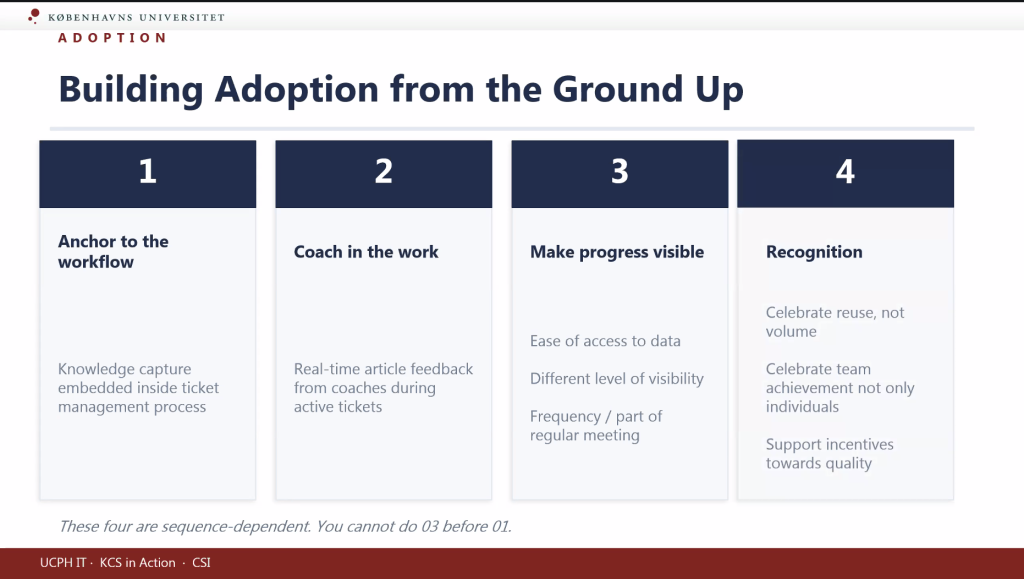
The journey took place over three years, with feasible and iterative change management.
Results
The team implemented a knowledge management and coaching system that:
- Connected ITSM tickets directly to knowledge and coaching workflows
- Provided role-based dashboards:
- Managers → team-level performance and trends
- Coaches → individual-level insights (for development)
- Enabled filtering by team, role, and source to identify patterns
This visibility also surfaced unexpected issues, including a technical bug that impacted resolution times, that demonstrated the broader value of trustworthy data.
Over time, the organization saw measurable improvements:
- First Contact Resolution: 51% → 76%
- Average Time to Resolve: 4.6 days → 1.4 days
- Link Rate: 18% → 64%
Just as important:
- Shift from quantity → quality in knowledge contributions
- Increased engagement through coaching and recognition
- Stronger alignment between daily work and organizational outcomes
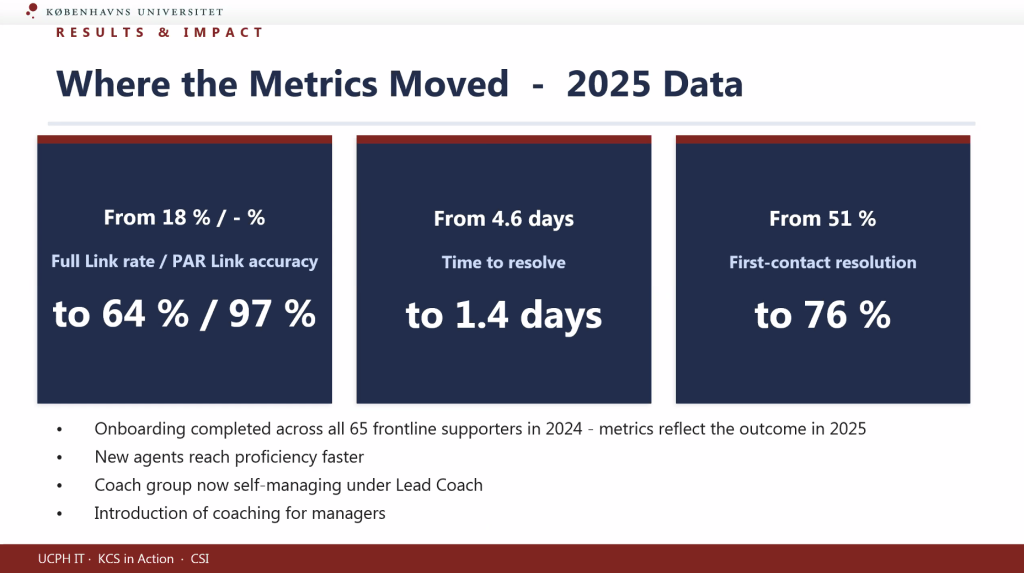
This case study reinforces a pattern we see across organizations: KCS adoption doesn’t fail because of tools but struggles when people, data, and leadership aren’t aligned early. Even in a complex, changing environment, this team demonstrated that scaling KCS is about building the system that lets it evolve.
Resources Shared
- Patrick’s deck
- VisionWillow offers KCS Aligned Services, which support KCS adoption and success.
- Upcoming Public Events
- KCS Training
- If you are interested in presenting at a future KCS in Action or being part of a Practitioner Panel on a topic, contact us
- Get notified about future events by signing up for the mailing list